
Central Coolant Filtration Systems for CNC & Industrial Machining
Filtra-Systems designs, manufactures, installs, and services central coolant filtration systems for production machining environments where multiple machines need clean cutting fluid delivered at consistent pressure, flow, temperature, and clarity.
Central coolant filters are custom-engineered from 50 GPM to 50,000 GPM to match the specific contamination load, fluid type, and machine count of your operation.
These central coolant filtration systems are engineered using data from thousands of installations and 30+ patents—so your equipment will always integrate into your existing floor layout instead of forcing you to redesign around it.
Now, discover six central coolant filter technologies and how each one is used.
Select a filter below to see technical specifications and available options.


How a Central Coolant Filtration System Works in a Production Environment
A centralized filtration system serves multiple CNC machines from a single remotely located filter rather than placing individual units at each machine.
Dirty coolant is pumped from each machine to the central filter using fluid transportation equipment.
It's then cleaned to the required micron level and returned to each machine at the correct pressure and flow.
Because all machines draw from the same filtered supply, every tool in the cell receives coolant at the same concentration, temperature, and clarity.
That consistency reduces variation in surface finish and tool wear across the production run.
Metal fines and chips are discharged at one central location instead of at every individual machine.
This simplifies maintenance and reduces the labor for managing coolant quality across a large number of machine tools.
Central machine tool coolant filtration systems also get you a larger filter capacity than individual units can provide, which is important in high-volume cells running continuous multi-shift operations.
For operations running 40 to 60 machines from a single system, a properly sized central coolant filtration system will reduce your operating and maintenance costs significantly compared to managing filtration at each individual CNC machine.

Central Coolant Filter Technologies by Application...
Six central coolant filter platforms—sized and configured for your specific application.
Each is engineered around a different filtration methodology, and the right choice depends on your cutting fluid type, contamination profile, machine count, and available floor space.
Take a look at these filters below to see detailed specifications and configuration options.
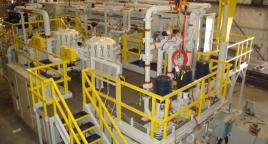
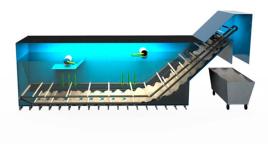
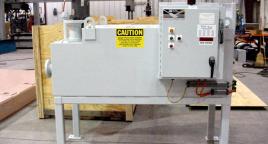
Continuous Running Systems: Vacuum and Rotary Drum Filtration
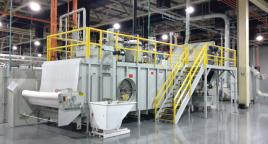
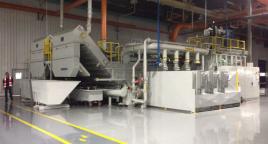
Vacuum filtration and rotary drum filtration are both designed for continuous operation without stopping for media changes or manual intervention.
Vacuum filtration uses a highly modular platform that can support individual machines or scale up to serve a central filtration system running up to 60 machines simultaneously.
The vacuum system draws coolant through a filter media belt, and spent media advances automatically as it becomes loaded.
Rotary drum filtration uses a permanent rotating cylinder constructed of laser-drilled holes or wedge wire that acts as the filtration septum.
As the drum rotates, contaminated coolant is filtered and clean fluid is discharged continuously. Both systems are suited for operations that cannot tolerate downtime for filter servicing.
Pressure Filtration and Rectangular Clarifiers
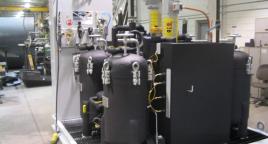
Pressure filtration uses a pump to push cutting fluid through a filtration membrane, removing suspended particles under controlled pressure.
This approach is effective across a wide range of fluid types and contamination loads and is commonly used in machine tool coolant skids filtration setups where consistent delivery pressure is required.
Rectangular clarifiers use a gravity separation methodology, allowing suspended solids to settle out of the fluid over time. The tanks are sized to the required flow rate and residence time for the specific contamination being removed.
Clarifiers are a practical choice for high-volume operations generating heavier chip loads where gravity separation reduces the burden on downstream filtration media.
Magnetic Filtration and Oil Delivery Systems
Magnetic filtration uses a set of magnetic bars submerged in dirty fluid to capture ferrous metallic particles before they reach the coolant loop.
It works well as a standalone solution for operations producing primarily ferrous swarf, and is frequently used as a pre-filter ahead of paper bed or vacuum systems to extend media life in mixed-contamination environments.
This oil delivery filtration system is designed in a modular skidded configuration to both filter oil to the specifications of the process and condition the oil for delivery.
This system is used where the cutting operation requires filtered and conditioned oil, rather than water-soluble coolant, delivered at machine-specified pressure and flow
Custom Design and Engineering for Every Central Filtration System
Every central coolant filtration system engineered, manufactured and installed is configured around the specific requirements of your process and operation.
There is no standard system that fits every machining environment, and the engineering process starts by evaluating your fluid type, flow rate, contamination load, machine count, and available space before specifying equipment.
You get systems designed to handle applications from 50 GPM to 50,000 GPM, covering individual machining cells up to large-scale production facilities running multiple shifts across dozens of machines.
Ready to discover how industries including automotive component manufacturing, aluminum stamping and drawing operations, carbide tool manufacturing, and general production machining across a wide range of part types are using central filtration systems?
As an inline coolant filter manufacturer with over 30 patented products, we have helped configure coolant filtration equipment that performs at the temperature, pressure, flow rate, and clarity your operation requires.
These systems are integrated into your facility, with full documentation and support provided at installation.
Evaluating coolant filtration suppliers? An engineer assesses your operation—flow rate, contamination type, floor space—and delivers a detailed sizing recommendation specific to your process.
Have a Filtration Question? Ask an Engineer Directly
Engineers configure central coolant filtration systems for production machining operations of every scale—sized to fit the floor, the process, and the budget."
Whether you're running a single machine or a full production line, your central coolant filtration system is configured to fit your floor, your process, and your budget.
Call us at 248-427-9090 or submit a contact form, and we will respond promptly.
Frequently Asked Questions
The number of machines a central system can support depends on the total coolant flow demand across all machines, the filtration technology selected, and the system capacity we size for your operation.
As an example, a vacuum filtration platform can support up to 60 machines running simultaneously from a single central system.
For larger cells or facilities running higher total flow rates, your systems will be engineered accordingly.
There is no fixed machine count limit across this full product range, and sizing is based on your actual GPM requirement rather than a machine count.
Vacuum filtration draws coolant through filter media using suction, which allows the media to load progressively and advance automatically without operator involvement.
It is well suited for continuous operations where stopping for media changes is not practical.
Pressure filtration pushes coolant through a membrane using a pump, which generates higher differential pressure across the media and can be effective for finer filtration requirements or fluids with higher viscosity.
The choice between the two depends on your fluid type, required filtration micron level, and how the system needs to operate during production.
GPM capacity is calculated based on the total coolant demand of all machines the central system will serve, plus a margin for peak demand and system losses.
Each machine tool has a specified coolant flow requirement at a defined delivery pressure. Summing those requirements across the full machine count gives the minimum system flow rate.
System design calculates your actual demand, then sizes the filter, pump, and distribution equipment to meet it reliably—shift after shift, not just on paper.
Not typically from a single shared system. Water-soluble coolants and oil-based cutting fluids require different filtration media, different delivery pressures, and are not compatible in a shared sump or filter loop.
If your facility runs machines on both fluid types, the practical approach is either separate central systems for each fluid type or individual machine filtration for machines running a different fluid than the central system.
An engineer evaluates your fluid compatibility requirements during system design and configures the system accordingly.
A central coolant filtration system concentrates all maintenance activity at one location rather than distributing it across every machine on the floor.
Filter media changes, pump maintenance, sump cleaning, and coolant quality checks all happen at the central unit.
For facilities running large numbers of machines, this typically reduces total maintenance labor compared to servicing individual units at each machine.
The tradeoff is that a central system represents a single point of failure for the full cell, which is why proper sizing and redundancy planning are part of how these systems are engineered.
Media options depend on the filtration technology and the contamination profile of the operation:
- Vacuum systems use a disposable paper or synthetic media belt that advances automatically.
- Drum systems use a permanent wedge wire or laser-drilled drum that does not require media replacement.
- Pressure systems can use cartridge, bag, or disposable media depending on the particle size and flow rate requirements.
- Magnetic systems use permanent or electromagnetic bars that are cleaned periodically rather than replaced.
The engineering team will specify the appropriate media type for each system based on your cutting fluid, particle type and size, and the coolant clarity required at the machine.
Not sure what type of filtration you need or have questions about your equipment?
Let our team of experienced applications engineers review your process to access your needs and make a recommendation that will be best for your business.

Explore Related Featured Projects
Below you will find some projects that have benefited from our technology.
