
Machine Tool Fluid Transfer Systems
A central coolant filtration system only performs as well as the equipment moving fluid through it. You want a machine tool fluid transfer system that manages the full coolant movement cycle, returning dirty coolant to your filtration unit and delivering clean coolant back to your machines at the settings each cutting operation requires.
Discover these two products in this category: the machine tool pump back and the machine tool utility skid.


What Happens When Fluid Transfer Is Not Engineered Correctly
Filtration gets most of the attention in coolant system design. The transport and delivery side is where unplanned downtime quietly starts.
Dirty coolant returning from your machines carries suspended solids. That fluid needs to travel at a specific velocity to keep those solids from settling out in your return lines.
When your transport velocity drops below the required threshold, solids accumulate in your piping, flow restrictions develop, and maintenance pulls your operation offline.
On the delivery side, clean coolant reaching your machines at the wrong pressure or temperature affects cutting performance and shortens tool life.
Fortunately, metalworking fluid transfer equipment is engineered and available to prevent both of those outcomes.
Fluid Transfer Products for Machine Tool Operations
In short, each product in this category addresses a distinct function within your CNC coolant delivery system. Understanding what each one does helps you determine what your facility needs and where gaps in your current setup may exist.
Machine Tool Pump Back
The machine tool pump back moves dirty, solid-laden coolant from your machines back to your central filtration system. It maintains the transport velocity required to keep solids in suspension throughout the return run, regardless of how far your machines are positioned from the filtration unit.
Without a properly sized pump back, distance alone creates the conditions for solids buildup and the maintenance problems that follow.
You see, because the pump back handles the return run at distance, it also frees up plant floor space that would otherwise be consumed by manual fluid handling or short-run piping workarounds.
Learn More about the Machine Tool Pump Back
Machine Tool Utility Skid
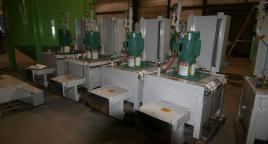
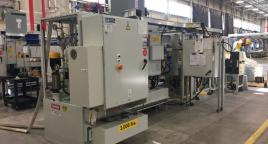
The machine tool utility skid sits on the clean coolant delivery side of your system.
It receives filtered coolant from your central filtration unit and locally communicates with each machine tool to direct coolant to the correct nozzle and cutting operation, supporting optimum lubricity at the point of cut.
Delivery settings include pressure boosting, valve actuation, spindle chilling, and secondary filtration where your process demands it.
The skid combines several components under a single user interface, which simplifies monitoring and adjustments across your floor.
How the Two Products Work Together
In a fully integrated coolant system, the pump back and utility skid operate as a pair.
The utility skid manages clean coolant distribution to your machines. Once the cutting operation is complete, the pump back collects the dirty coolant and returns it to filtration at the correct transport velocity.
The bottom line, that closed loop maintains consistent coolant quality, extends fluid life, and keeps your maintenance schedule predictable.

Designing These Fluid Transfer Systems
The fluid transfer side of your coolant system will be engineered alongside the filtration equipment, not independently of it. Floor layout, machine count, line distances, and the specific cutting operations running on each machine all affect how your pump back and utility skid need to be configured.
When you are building a new central coolant system, products are sized to fit your facility from the start.
If you have an existing system that is not performing as expected, your transport and delivery will be evaluated before recommending changes to your filtration unit.
Consider this, in many cases your filtration capacity is sufficient and the fluid transfer configuration is where the problem originates.
Industries That Rely on Machine Tool Fluid Transfer Equipment
When your facility runs automotive components, aerospace parts, or precision machined work, your central coolant system is operating at a scale where pump back and utility skid performance directly affects your output quality and uptime.
If you are running multiple machine tools from a single filtration unit, pressure regulation and transport velocity management are what keep every machine on your floor performing consistently.
Regardless of your industry, if you are operating a central coolant system, the fluid transfer side of that system deserves the same engineering attention as the filtration unit itself.
Have questions about the fluid transfer side of your coolant system?
Our engineering team reviews your floor layout, machine count, line distances, and cutting operations to specify the right configuration for your facility. Contact us to get started.
Frequently Asked Questions
Transport velocity is the minimum flow speed required to keep suspended solids moving through your return piping rather than settling on the pipe walls.
Every coolant carries a load of chips, fines, and metalworking debris from the cutting zone. If that fluid slows below the transport velocity threshold, solids drop out of suspension and accumulate inside the pipe.
Over time that buildup restricts flow, increases pressure loss across your system, and requires manual cleanout to clear.
The correct transport velocity depends on your pipe diameter, line length, and the solids content of your coolant. A properly sized pump back maintains that velocity throughout the return run.
High-speed machining operations are where spindle chilling makes the most measurable difference.
At elevated spindle speeds, heat generated at the bearing and cutting interface accumulates faster than ambient cooling can manage.
Now, when your coolant delivery temperature is not controlled, that heat accelerates bearing wear and introduces thermal growth in the spindle that affects your ability to hold tight tolerances over a production run.
The utility skid conditions coolant temperature before it reaches your spindle, keeping the thermal environment stable enough for precision work.
A standard coolant pump moves fluid from a reservoir to the machine at a fixed output. Your new machine tool utility skid would be a configured system that receives clean coolant from your central filtration unit and manages how that coolant is delivered to multiple machines, with settings adjusted for each machine's specific requirements.
It will handle pressure regulation, valve actuation, temperature conditioning, and secondary filtration in one integrated package under a single interface.
The difference is between moving fluid and actively managing how that fluid is delivered across your operation.
Yes. when your central filtration unit is performing adequately but your coolant system is still experiencing downtime or inconsistent performance, adding or reconfiguring the pump back and utility skid components is often the correct next step.
First, your existing setup is evaluated confirming where the gap is before recommending any equipment.
Many times, retrofitting is a practical option for facilities that have invested in filtration capacity but have not yet addressed the transport and delivery side of the system.
The key inputs are your floor layout showing machine positions relative to the filtration unit:
- The number of machines on your system.
- The pipe diameters and run lengths for both return and delivery lines.
- The coolant type in use, and the cutting operations running on each machine.
If spindle chilling is a requirement, spindle speed and bearing load data are also useful. If you are early in the design process and do not have all of that information yet, our team can walk you through what is needed before the sizing conversation begins.
Not sure what type of filtration you need or have questions about your equipment?
Let our team of experienced applications engineers review your process to access your needs and make a recommendation that will be best for your business.

Explore Related Featured Projects
Below you will find some projects that have benefited from our technology.
